
«We saw the East as much too homogeneous»
Thirty years ago, Switzerland recognised the independence of the states of the former Soviet Union. As it set about supporting these countries, it recognised that this was far from a uniform bloc. Switzerland's aim was to support them on the road to democracy and a market economy. A complex challenge and one that Switzerland is rising to: a look back at 30 years of cooperation with Eastern Europe.
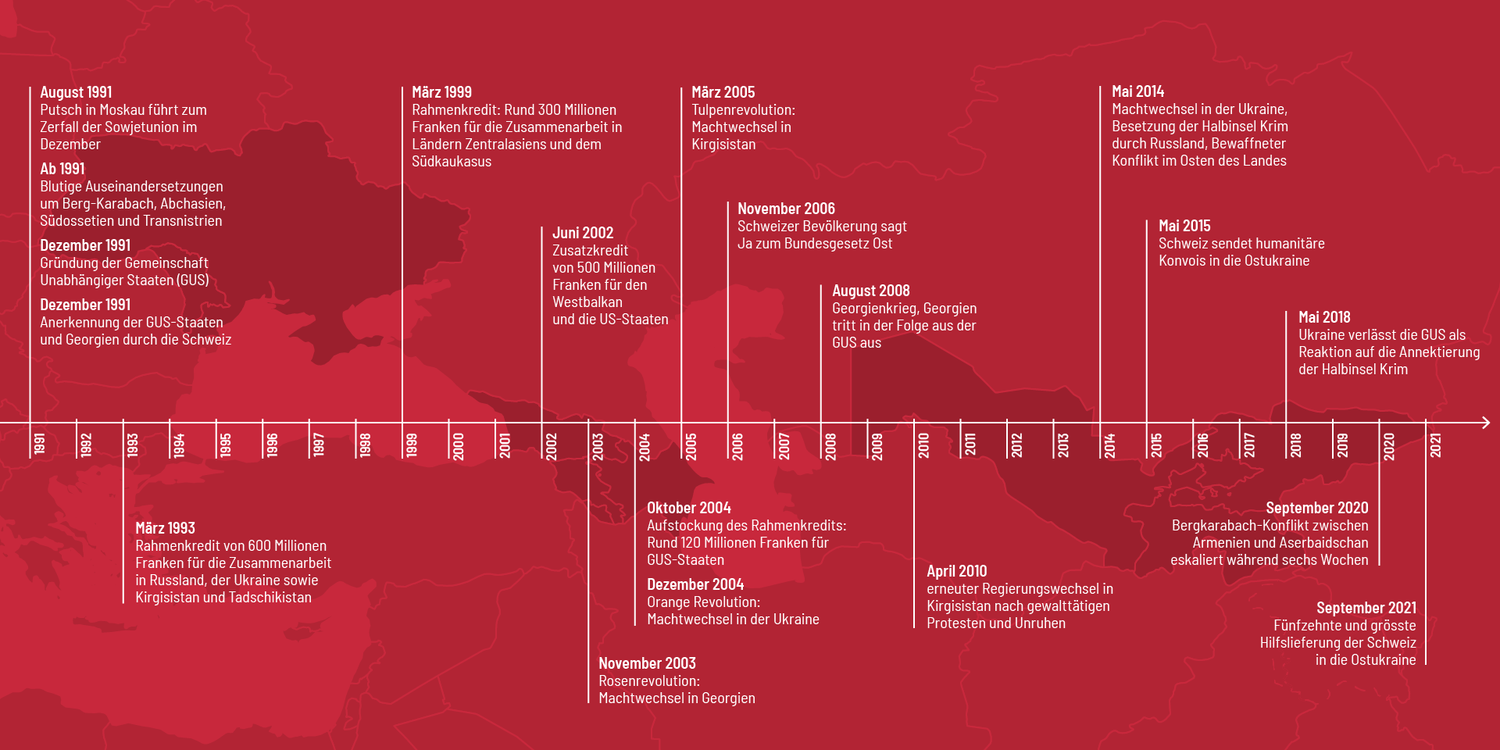
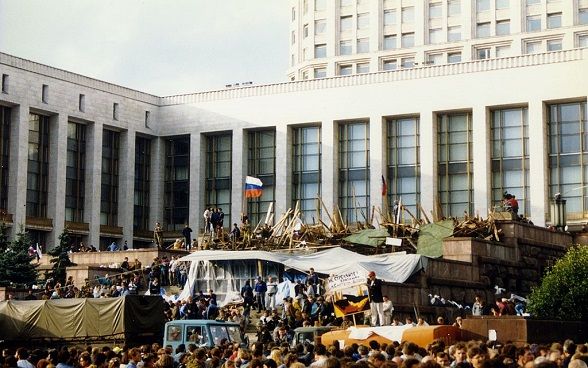
Mikhail Gorbachev, the last president of the Soviet Union, had actually planned to reform the Soviet Union into a confederation of sovereign states. The Union Treaty on the creation of the union of sovereign states was accepted by a large majority in the first and only referendum in the Soviet Union in March 1991.
But, as is often the case, the plans of politicians were out of sync with reality. On 19 August 1991, a day before the signing of the new treaty, rioters attempted to seize power in Moscow. Mikhail Gorbachev was placed under house arrest at his holiday home in Crimea. But there was something the coup plotters had not reckoned with: widespread resistance from the public, and a lack of support from large parts of the police and military.
The coup failed, but still led to the collapse of the Soviet Union. In December, Mikhail Gorbachev stepped down as general secretary of the Communist Party and therefore as head of state.
Recognising the independence of the former Soviet republics
Former Soviet republics, such as the Baltic states, had already declared their independence before the collapse of the Soviet Union, while others joined the Commonwealth of Independent States on 21 December. Shortly afterwards, Switzerland recognised the independence of the Russian Federation, Ukraine, the Republics of Belarus and Moldova, and Kazakhstan, Georgia, Armenia, Azerbaijan, Uzbekistan, Turkmenistan, Tajikistan and Kyrgyzstan.
What had previously been perceived by the West as a uniform bloc behind the Iron Curtain, suddenly emerged as a tapestry of multi-ethnic states. «We saw the East as much too homogeneous,» said former head of the Cooperation with Eastern Europe department, Remo Gautschi, in 1999.
These countries, some of which were unprepared for independence, faced considerable challenges, as the collapse of the Soviet Union also meant the collapse of a centralised government and economic structure. There were barely any national state institutions. The economy shrunk by 50-60%. Meanwhile, minority conflicts that had been simmering below the surface boiled over into bloody clashes.
Supporting self-initiated development processes
In 1993, Switzerland allocated financial resources for cooperation with Eastern Europe in Russia, Ukraine and Central Asia. Its aim was to support these countries in their transition from a one-party government with a command economy to a pluralist democracy with a social market economy. Owing to its independence and neutrality, Switzerland was well placed to do so, and was the first European country to obtain a cooperation agreement with Russia in 1996. It quickly became clear that expanding infrastructure and advancing economic development made little sense if steps were not taken towards pluralism and democracy. In addition, peacekeeping played an increasingly critical role from the late 1990s.
Switzerland's aim was to support these countries in their transition from a one-party government with a command economy to a pluralist democracy with a social market economy.
It is key that parties to a conflict are willing and able to pursue the path to peace on their own. The same applies to tasks of development cooperation in other areas: Switzerland's contribution involves supporting countries with development processes that they have sought and pursued on their own. The processes of change set in motion 30 years ago require time and a change of mindset. The key to the success of Switzerland's activities in these countries has always been developing and maintaining relationships of trust. The human factor is crucial, as shown by selected projects from 30 years of cooperation with Eastern Europe.
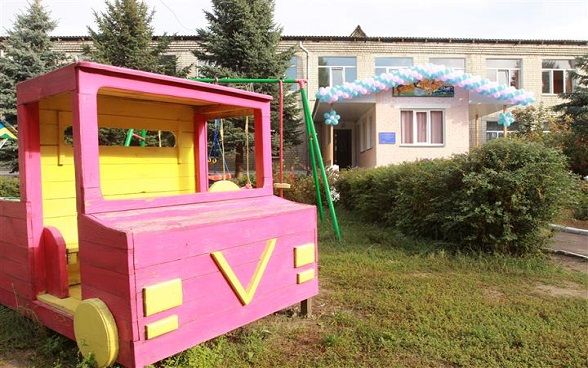
Cooperation with Eastern Europe in post-Soviet states today
The SDC has developed its capacity to respond to different conditions and needs in post-Soviet states. In collaboration with its partners, Switzerland has played an important role in developing bespoke solutions to complex problems and reforms. Swiss support, coupled with its long-term commitment, is therefore held in very high regard in the post-Soviet states.
The goal is to strengthen the rule of law, democracy, the social market economy and civil society, with an emphasis on particularly vulnerable groups and gender equality. With slight adaptations, Switzerland continues to work in areas where it can bring added value:
- Good governance, public services and combating corruption
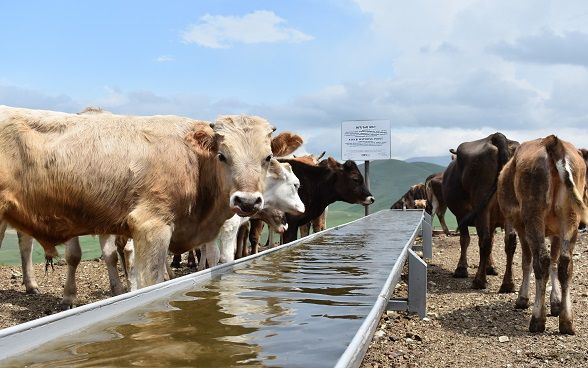
- Economic development, strengthening the private sector and vocational education and training
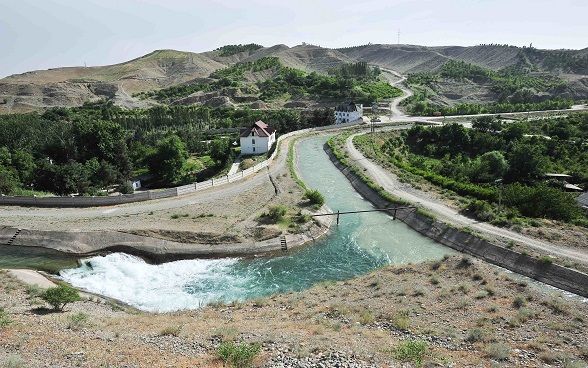
- Climate change mitigation and adaptation, and water and energy management
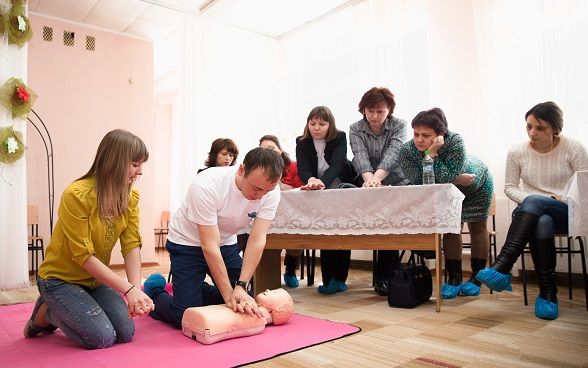
- Health
The objectives and strategy of cooperation with Eastern Europe in post-Soviet states are consistent with the major strategic frameworks of action set out in Switzerland's International Cooperation Strategy 2021–24. In line with Switzerland's Foreign Policy Strategy and the UN's 2030 Agenda, Switzerland works to create decent jobs, address climate change, promote the rule of law, and reduce the causes of forced and irregular migration in four geographical focus regions.
Links
- The SDC's cooperation with Eastern Europe
- Blue Peace: Water as an asset for peace
- Prison reform in Ukraine
- Livestock development in southern Armenia
- Dodis research centre (Diplomatic Documents of Switzerland): 30 years ago – the dissolution of the USSR and the recognition of the successor states
Documents
Contact
Eichenweg 5
3003 Bern